fbpx
Digital Transformation: A Step-by-Step Guide for Chiropractic Practices

Digital Transformation: A Step-by-Step Guide for Chiropractic Practices

Digital Transformation:

A Step-by-Step Guide for Chiropractic Practices


In a world where technology reshapes landscapes overnight, no industry remains untouched – and chiropractic care is no exception. The burgeoning digital wave promises enhanced healthcare, heightened patient satisfaction, and substantial growth in revenue, marking technology not just as an asset but a necessity for chiropractic practices aiming to thrive. 

Embracing technology is no longer about staying ahead; it’s about not being left behind. Yet, the rapid pace at which technology evolves can be daunting, and staying abreast of the latest advancements is a challenge. 

Today, we’re peeling back the layers of digital transformation with an exclusive guide crafted for chiropractors and practice owners. This step-by-step guide is your beacon in the digital shift, ensuring you harness the full potential of technological advancements to enrich your practice and elevate patient care. 
 

Step 1: Assess Your Practice’s Digital Health 

In the initial phase of digital transformation, you must take a comprehensive look at your current use of technology.  

This involves evaluating how your patient records are managed, the efficiency of appointment scheduling systems, and the effectiveness of patient communication methods.  

The goal here is to identify gaps where technology can make a significant impact. For example, a practice might realize that manual appointment scheduling leads to frequent errors, indicating a need for a digital scheduling system.  

Similarly, if patient records are still kept in physical files, transitioning to an Electronic Health Records (EHR) system could greatly enhance data accessibility and security. 

To begin this assessment, you can: 

  • Conduct a survey among staff to understand the challenges they face with current processes. 
  • Review patient feedback for insights into their experience and areas needing improvement. 
  • Analyze the practice’s operational workflow to pinpoint inefficiencies. 


Step 2: Define Your Digital Transformation Goals 

Once you’ve assessed your current digital landscape, it’s crucial to define what you aim to achieve through digital transformation.  

For chiropractic practices, goals might include improving patient experience, enhancing treatment outcomes, reducing administrative burdens, or increasing operational efficiency.  

For instance, if patient feedback suggests a need for more personalized care, implementing a patient portal for personalized treatment plans and direct communication could be a goal.  

Similarly, if administrative tasks are consuming too much staff time, automating these processes could be another objective. 

  • Objective Setting: Identify specific, measurable, achievable, relevant, and time-bound (SMART) objectives that align with your practice’s vision and patient care philosophy. 
  • Benchmarking: Consider what success looks like by benchmarking against industry standards or setting internal baselines for improvement. 
  • Prioritization: Not all goals are created equal. Prioritize your objectives based on their potential impact on patient care and practice growth. 

Step 3: Develop a Strategic Plan

Creating a strategic plan is where vision starts to take shape. This plan outlines how your chiropractic practice will integrate digital tools to meet your transformation goals. It involves determining the technology stack that will best support your objectives, setting a realistic timeline for implementation, and establishing key performance indicators (KPIs) to monitor progress. 

A successful plan should include: 

  • Technology Selection: Based on the gaps identified in Step 1, select technologies that address your specific needs.  
  • Training and Support: Outline a training program for your team to ensure they are proficient in using new technologies. 
  • Timeline: Set achievable milestones for technology deployment, ensuring there is minimal disruption to daily operations. 
  • Budget: Allocate a budget that covers technology acquisition, training, and any unforeseen costs. 
  • Monitoring and Evaluation: Establish KPIs related to patient satisfaction, staff productivity, and financial performance to evaluate the impact of digital transformation. In most cases digital tools give access to dashboards and data where you can track your patients and practice performance.  

Step 4: Choose the Right Technologies 

After setting your digital goals, selecting the right technologies is pivotal.  

The technologies you adopt should directly support your practice’s objectives, whether that’s enhancing patient communication, improving record-keeping, or streamlining appointments. 

Consider technologies like: 

  • Patient management systems that offer comprehensive solutions for scheduling, billing, and communications. 
  • EHRs for secure, efficient patient record management. 
  • Digital tools for patient engagement, including apps that allow patients to track their treatment progress. 


*And here’s some exciting news: on March 20th, we’re going to announce a groundbreaking tool that could be the key to revolutionizing your chiropractic practice.  


This innovative technology is designed with your needs in mind, aiming to simplify your practice’s transition into the digital age. As you ponder the steps toward digital transformation, this upcoming announcement could very well introduce the technology solution you’ve been looking for. 


Step 5: Manage Change Effectively 

Successfully integrating new technologies into your chiropractic practice requires effective change management.  

This involves preparing your team for the transition, addressing any concerns, and ensuring they understand the benefits of the new systems. 

  • Communicate Clearly: Keep your team informed about the upcoming changes, the reasons behind them, and how they will be implemented. Open communication helps reduce resistance and builds a supportive environment. 
  • Provide Training: Ensure your staff receives comprehensive training on new technologies. Proper training is key to maximizing the benefits of digital tools and minimizing disruptions during the transition. 
  • Seek Feedback: Encourage your team to provide feedback on the new systems. Their insights can help you make necessary adjustments and improve the implementation process. 


Step 6: Implement Incrementally 

Transitioning to new digital solutions should be a gradual process to ensure a smooth adaptation for your team and patients.  

Start with the most critical areas identified in your assessment that will bring immediate benefits to your practice. 

  • Phase Implementation: Break down the digital transformation into manageable phases, prioritizing tools and systems that address your most urgent needs first. 
  • Monitor and Adjust: After each phase, evaluate the impact on your practice’s operations and patient care. Use feedback to make necessary adjustments before moving on to the next phase. 
  • Celebrate Milestones: Acknowledge and celebrate the successful implementation of each phase with your team. This helps maintain morale and momentum throughout the process. 


Step 7: Measure Progress and Iterate 

After implementing new digital tools, it’s crucial to continuously measure their impact on your practice. Use the data collected to evaluate how well these technologies are meeting your goals. 

  • Track Key Metrics: Identify metrics that align with your digital transformation objectives, such as patient satisfaction scores, appointment no-show rates, or revenue changes. 
  • Solicit Feedback: Regularly ask for feedback from both staff and patients to gain insights into the user experience and areas for improvement. 
  • Adjust and Evolve: Use the insights gathered to make informed adjustments to your digital strategies. Technology and patient needs will continue to evolve, so your approach should be flexible and adaptable. 


As you work through these steps, remember to stay tuned for a significant announcement on March 20th. We’re excited to introduce a transformative tool designed specifically for the chiropractic industry, which might just be the technology you’re looking to implement in your practice. 

Digital transformation in the chiropractic industry is not merely a trend; it’s a strategic approach to ensuring your practice not only survives but thrives in the modern healthcare ecosystem.  

By assessing your current technology use, setting clear objectives, planning strategically, choosing the right technologies, managing change effectively, implementing incrementally, and continuously measuring progress, you’re paving the way for a practice that is efficient, responsive, and patient-centered.  

Remember, the journey of digital transformation is ongoing and evolves with your practice’s and patients’ needs.  

Stay informed, stay adaptable, and look forward to reaping the benefits of digitally advanced chiropractic practice. 

 

To further explore how technology can transform your practice, join us at our annual live event on June 22nd, The Business Adjustment Summit, focused entirely on leveraging technology in chiropractic care.  

Dive deep into the latest tools, trends, and strategies with experts and peers alike.  

Take advantage of our special early bird pricing now and step into the future of chiropractic care. 

Embrace innovation, enrich your practice, and elevate patient care.  


Your questions and feedback are always welcome and appreciated!
Connect with us on Instagram or email us at [email protected]

TMD: Five Steps to Effective Conversations in Leadership

TMD: Five Steps to Effective Conversations in Leadership

Two Minute Drill:

Five Steps to Effective Conversations in Leadership

What’s up Kaizenovators, Happy Tuesday Two Minute Drill. Today’s topic of conversation is important conversations. As leaders, we get to have conversations with people that sometimes are not always easy. Sometimes they’re challenging conversations. I’m going to share with you my five-step process for having challenging and important conversations with members of our team. 

Speak, Listen, Grow…


The first thing that I like to do is to write things down. I prefer to perform a brain dump and get everything I want out on paper so that I can organize my thoughts and be prepared.

Part of that preparation involves using tools like ChatGPT or creative writing AI tools, which help me formulate my words more effectively or give me ideas to inspire me to become the most effective communicator possible. Writing things down is very important.

Number two is, when you’re in the meeting, be curious. I typically start with questions so that I can gain some perspective and context about where the person is coming from.

After asking questions, the next thing is to be an empathetic listener. Often, as humans, we’re quick to think about our response, but the more you can focus on just listening to people and being empathetic and understanding where they’re coming from, the more effective the conversation will be.

The fourth thing is being direct. Look them in the eye and be direct with any feedback you may have for them. People appreciate directness. They don’t want to have to read between the lines. They don’t want the compliment sandwich. Just tell them what’s on your mind, tell them what you’re thinking.

The last thing is ensuring that you have a follow-up. It might be sending a follow-up email summarizing what was discussed, or I ask them to send a follow-up email based on what they heard or what they understood from the conversation.

Write things down, be curious, be an empathetic listener, ensure that you’re direct, and then ensure that you have a follow-up.

Those are my five steps for having important conversations with members of my team to support them, help them grow, and help take all of us to the next level.

That’s this week’s Two Minute Drill.

You guys have a great week, and I’ll talk to y’all next week.

Join us at our annual live event on June 22nd, The Business Adjustment Summit, focused entirely on leveraging technology in chiropractic care.  

Dive deep into the latest tools, trends, and strategies with experts and peers alike.  

Take advantage of our special early bird pricing now and step into the future of chiropractic care. 

Embrace innovation, enrich your practice, and elevate patient care.  


Your questions and feedback are always welcome and appreciated!
Connect with us on Instagram or email us at [email protected]
TMD: Why Standardization First Makes Customization Better

TMD: Why Standardization First Makes Customization Better

Two Minute Drill: Why Standardization First Makes Customization Better


What’s up Kaizenovators, Happy Tuesday Two Minute Drill. Today’s topic of conversation is Customization versus Standardization. Over the years, we’ve implemented so many different technology platforms in our practices. One of the painful lessons I learned early on was not to customize too soon.

Customization vs. Standardization in Tech


We bought this platform called SuccessFactors. It’s essentially a goal management and human performance evaluation tracking system. I loved it. I thought it was great. My team hated it, and I’ve never lived it down over the last 10 or 15 years. We’re not using it anymore. It was bought by SAP, and we’re not using it anymore. 

When we got this product, I was like, “Oh my God, this is great.” And when we met with the sales team, all I wanted to do was make it my own. I wanted to customize it; I wanted to change this and change that. What I learned through that process is that I do not know more than the developers. We made these customizations, and it ended up not really working that great for us. 

Some of the feedback that I got later down the road was, “If we would have helped you implement this platform, we would have told you not to customize, just use it for at least six months the way that it is, and then if you feel like you want to make some changes, we can talk about that later on.” 

We spent time and money customizing it, and it ended up not meeting our needs. We probably would have learned a lot more and maybe even had a better experience if we had just used the product the way it was designed. 

Now that I’m selling technology, I’m dealing with the same thing, but on the opposite side.  

I have people asking me, “Well, can we customize this? Can we customize that?” I’m like, “There’s a reason why we built it this way, people.” So just try to use it, experience it, then give us feedback because your feedback will be a lot more valuable for us but most importantly, for you, once you’ve used the product the way that it’s designed.  

When you’re implementing technology in your practices, just try to use the standard product first, at least for a short period of time, so you can provide valuable feedback to the vendor and then, if necessary and if available, customize it afterwards. 

So that’s this week’s Two Minute Drill, you guys.  

Hope you’re having a great week.  

Join us at our annual live event on June 22nd, The Business Adjustment Summit, focused entirely on leveraging technology in chiropractic care.  

Dive deep into the latest tools, trends, and strategies with experts and peers alike.  

Take advantage of our special early bird pricing now and step into the future of chiropractic care. 

Embrace innovation, enrich your practice, and elevate patient care.  


Your questions and feedback are always welcome and appreciated!
Connect with us on Instagram or email us at [email protected]
Balancing Tradition and Innovation: Evolving Your Chiropractic Practice with Technology 

Balancing Tradition and Innovation: Evolving Your Chiropractic Practice with Technology 

Balancing Tradition and Innovation:

Evolving Your Chiropractic Practice with Technology 


Chiropractic care has long been rooted in tradition, focusing on manual adjustments, personalized patient care, and a holistic approach to health.  

Yet, as we move further into the digital age, technology integration offers unprecedented opportunities to enhance these traditional practices, streamline workflows, and improve patient outcomes.  

Let’s explore how modern tools can transform each aspect of your chiropractic business, making the leap from traditional methods to innovative solutions. 


Traditional Practice vs. Innovative Solutions 


  • Patient Intake and Record-Keeping 

Traditional: Paper forms, manual entry into desktop-based systems, and physical filing cabinets have been the backbone of patient intake and record-keeping.  

This method is time-consuming and prone to errors or loss. 

Innovative: Digital intake solutions and cloud-based Electronic Health Records (EHR) streamline the process, improving accuracy and accessibility.  

Platforms like Genesis Chiropractic Software offer secure, efficient ways to manage patient records, reducing paperwork and freeing up time for patient care. 

  • Diagnosis and Treatment Planning 

Traditional: Diagnosis has relied heavily on physical examinations and static imaging techniques, with treatment plans often communicated verbally or through printed materials. 

Innovative: Advanced imaging technologies and AI-driven diagnostic tools provide more precise assessments.  

New platforms offer dynamic, real-time insights into a patient’s condition, while AI algorithms can suggest customized treatment plans that adapt over time. 

  • Home Exercise Programs 

Traditional: Traditionally, chiropractors would prescribe home exercises using printed handouts.  

This method, while effective, lacked personalization and adaptability, often resulting in a one-size-fits-all approach to aftercare. 

Innovative: Today, there are digital platforms that allow chiropractors to prescribe tailored exercise programs directly to patients’ smartphones. These programs can be updated in real time, based on symptoms and progress, thanks to AI integration.  

This not only enhances patient engagement and adherence but also provides a more dynamic and responsive approach to home care. 

  • Patient Education and Engagement 

Traditional: Patient education typically involved brochures, posters, and face-to-face discussions.  

While informative, these methods limited the amount and depth of information shared. 

Innovative: Online platforms and apps offer interactive and engaging ways to educate patients about their conditions, treatments, and progress.  

  • Marketing and Patient Retention 

Traditional: Word of mouth, local advertising, and community involvement have been the mainstay of chiropractic marketing and patient retention strategies. 

Innovative: Digital marketing strategies, including social media, email newsletters, and SEO, reach wider audiences more effectively.  

Patient engagement platforms now automate appointment reminders, follow-ups, and reviews, improving patient retention and satisfaction. 

  • Embracing the Future: Your Invitation to Innovate 

As we look towards the future of chiropractic care, the integration of technology not only streamlines operations but also significantly enhances the patient’s experience and treatment outcomes.  

The juxtaposition of tradition and innovation presents a pathway to a more efficient, effective, and patient-centered practice. 

To further explore how technology can transform your practice, join us at our annual live event on June 22nd, The Business Adjustment Summit, focused entirely on leveraging technology in chiropractic care.  

Dive deep into the latest tools, trends, and strategies with experts and peers alike.  

Take advantage of our special early bird pricing now and step into the future of chiropractic care. 

Embrace innovation, enrich your practice, and elevate patient care.  


Your questions and feedback are always welcome and appreciated!
Connect with us on Instagram or email us at [email protected]
TMD: Empowering Leaders: A Mastermind Weekend’s Key Takeaways

TMD: Empowering Leaders: A Mastermind Weekend’s Key Takeaways

Two Minute Drill: Empowering Leaders – A Mastermind Weekend’s Key Takeaways


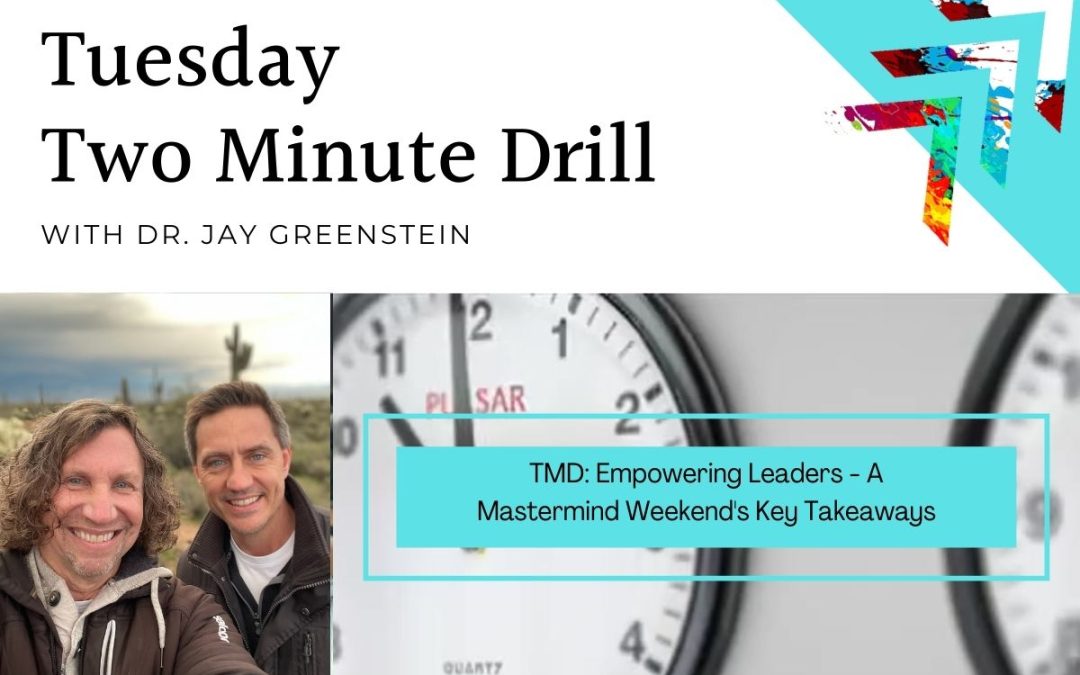
What’s up Kaizenovators, Happy Tuesday Two Minute Drill. I’m here with my very good friend, Dr. Kevin Christie. We attended his mastermind this weekend. It was the first West Coast mastermind for Kevin’s new group, an awesome gathering of folks. Right now, we are in the Sonoran Desert. 

Leadership Lessons


Dr. Kevin has a couple of messages about life.  

“We’ve learned a ton about leadership and the mindset surrounding it. One key takeaway from this weekend, as Jay discussed, was truly about providing leadership for your team, ensuring no stone is left unturned.  

It’s about ensuring that processes in your practice are actively happening and leading your team, not just expecting things to happen.  

You must actively guide them, which involves changing your mindset about what leadership means. This was particularly resonant for me because I’ve been on a journey for the last year and a half to improve my leadership skills. 

I gained a lot from this weekend in terms of taking that leadership knowledge and applying it to ensure we have the right processes and people in place, and truly leading them.  

One thing Jay said that struck me was the shift from always having to nag my team for their reports to having them self-audit and report back, empowering them to track their own progress. This empowers them to grow and take steps in their leadership journey, which I found incredibly valuable.” 

What I took away from this weekend was a reinforcement of how amazing life is when you share it with people you love, work with, and connect with, especially in remarkable groups like the mastermind Kevin has created, both on the East Coast—”What up, East Coast people?”—and the West Coast.  

It just makes life better. So, build your connections, because, at the end of the day, that’s what’s important. 

Keep growing, enhance your leadership, and improve your team. 

Have a great week, and I’ll talk to y’all next week. 


Your questions and feedback are always welcome and appreciated!
Connect with us on Instagram or email us at [email protected]
TMD: Behind the Scenes of Our Latest Technology Launch

TMD: Behind the Scenes of Our Latest Technology Launch

Two Minute Drill:
Behind the Scenes of Our Latest Technology Launch


What’s up Kaizenovators, Happy Tuesday Two Minute Drill. Today’s topic of conversation is launch. Last week, you didn’t see a TMD from me because we launched our second technology platform last Tuesday. As I was in the podcast studio at the launch event, watching the launch video we created, it was a surreal moment. I can’t believe we did this. 

The Road to Launch


Then, I started to reflect on what got us to this place. How did we get here? And so, I just want to share some of those ideas with you, in case you’re thinking about doing something that you’ve never done before but that you want to do. 

The first thing is to do your research. You must know there’s a need in whatever area you’re going to be driving a service or a product. 

Do market research, talk to as many people as you can, see what kind of problems exist, and how your solution is going to help these people solve their problems. 

Second, build alliances, build your network, and make sure that you’ve got people who understand the challenges, understand your solution, and can support you in your journey to create value, however you’re going to be creating it. 

Lastly, be scrappy as hell, like literally don’t give up. What’s super interesting is that there have been other folks, you may want to call competitors, in our space. 

Other people have built similar technology products, and some of those people are just no longer here. They’re gone, and we’ve just been scrappy. We never give up. 

We’re always working hard to get to that next level and take that next step, and we got to this milestone. We launched our second product. 

Again, it’s just the beginning, and I am so excited. 

That’s this week’s Two Minute Drill. 

You guys launch. Those are the three rules around launching. Hope you enjoyed it. Have a great week, and I’ll talk to y’all next week. 


Your questions and feedback are always welcome and appreciated!
Connect with us on Instagram or email us at [email protected]