by Kaizenovate Team | Aug 10, 2016 | Blog
Listen in as Dr. Fabrizio Mancini and Dr. Jay Greenstein discuss all the great opportunities for learning at FCA National. The largest event in Chiropractic is a can’t miss!
View this empower 1/2 hour series, hosted by Dr. Fab Mancini, to address and overcome common issues in Chiropractic practice. Hear this presenter live at the upcoming FCA Convention.
by Kaizenovate Team | Aug 8, 2016 | Blog
Dr. Jay Greenstein talks about how he overcame various obstacles and challenges while building six chiropractic practices. Check out this episode of Grow My Revenue Business Cast!
by Kaizenovate Team | Jul 8, 2016 | Blog
IN THIS MONTH’S ARTICLE, WE’RE GOING TO BE DISCUSSING THE FIFTH ELEMENT OF THE ENTREPRENEURIAL OPERATING SYSTEM (EOS), ISSUES. REMEMBER, THE SIX MAJOR CATEGORIES OF DISCUSSION INCLUDE:
- Vision
- People
- Data
- Process
- Issues
- Traction
Running a successful business means getting really good at identifying and tackling issues. As Good to Great author Jim Collins has said, great companies are able to “face the brutal facts.” Your practice’s success is directly proportional to your ability to solve your problems. This is not new information. In the well-known book by author Napoleon Hill, Think & Grow Rich, he cited a study that analyzed 25,000 people who had experienced failure. Procrastination, not making a decision, was one of their major causes of failure. In contrast, analysis of several hundred millionaires revealed that every one of them had the habit of reaching decisions quickly and altering them slowly. The fact of the matter is most teams discuss the heck out of problems, but rarely do they have efficient and effective ways to solve them. So how do you reverse that trend?
- Set the tone: First you have to have an environment where EVERY and/or ANY person on your team can speak freely without fear of reprisal. This is not always an easy environment to create, especially when you and your team are not used having frank conversations. Sitting down with your team and explaining why it’s so important to be able to speak freely to solve the ongoing issues of the clinic, and helping them understand that you won’t, and they should not and cannot, take any of these issues personally, is a good first step. Further, before having that first meeting, I highly recommend having your staff read Patrick Lencioni’s book, Five Dysfunctions of a Team. This is a must read and explains the five elements each team must have to be high performing and have fun working together.
- Identify Your Biggest Issues and Create an Issues List: Once you’ve had preliminary discussions with your team and they’ve read Five Dysfunctions, now it’s time to have a second discussion. Ask them what they thought of the book, what they liked and what they didn’t like. Also ask them to rate, on a scale from 1 (worst) – 5 (best), how your clinic performs for each dysfunction. It’s a great starting point for the issues list! If you have areas where you’re not performing well as a team, then you need to put that item on the issues list. The issues list is used to identify any and all areas that are holding back your practice from its mission. When you start creating an issues list for the first time (I like to use a whiteboard or poster paper), it can be very lengthy. That’s ok. The first step in this process is to recognize that all businesses have issues, and to have the courage to face them head on is the right step in the right direction. Once you have exhausted all of your issues on this list, now group together issues that are the same or similar. Once that is completed, identify your top three issues that you must solve and move to the next step.
- Discuss: Most companies don’t do a very good job in this area. They discuss and discuss and their discussions never lead to solutions. When people say the same things over and over again in an issues discussion, we call that “politicking”. It’s trying to lobby for your position and it’s a huge time waster. When you or any member of your team does that, then “throw the politicking flag” and tell the individual, you heard them, it’s on the record, and unless there is anything new to say, we need to move on to the next person. Further, another “communication penalty” is “the tangent.” The tangent goes something like this…
Dr. Smith: “So now that we’ve identified one of our three biggest issues, insurance claim rejections, let’s discuss some of the underlying causes.”
Sally, the insurance CA: “The biggest problems I see on these rejections are data entry. So if Jane was able to double check her work before sending the file to me, I could see a drastic reduction in denials and a great increase in our payments.”
Jane, the front desk CA: “Well that’s all fine and good but the real problem is that the am sun shines in on the computer screen. When I try to enter the information, it takes too much time because of the sun and then to go back and check it is just not feasible. If we could just upgrade our computer to the brand new iMac, then it would really help. I saw one on the online apples store when I was looking for a gift for my sister’s baby shower. I think we could afford a new one…”
TANGENT ALERT! The am sun really has nothing to do with her double checking her work because you have blinds in your office! Certainly, if she stopped shopping online during work hours, I’m sure she could find the time to ensure her work was perfect! Tangents kill productive conversations because they throw the emphasis off the real problem. When it happens, throw the “tangent alert flag” and get back on track!
The purpose of the discuss step is to really dig down to the underlying cause of the problem. For instance, if claims are being rejected by the carriers and that is your issue, what’s the core reason behind it? Is it data entry, a problem with the billing software? A problem with the clearinghouse? The insurance company making errors? Once you know the root cause (see Six Sigma last month) you can move on to the next step.
4. Solve! Now that you’ve identified the root cause of the issue, it’s time to solve it, and move your practice forward. Gino Wickman, founder of EOS and author of the book Traction, states in his book,
“George Perles, the head football coach of the Michigan State Spartans from 1983 to 1994, once gave a dinner talk at a function I attended. He shared a mantra from his days as an assistant coach for the Pittsburgh Steelers during their heyday in the 1970s. He said, ‘We made every decision like we were going to the Super Bowl,’ and they ended up winning the Super Bowl four times. That is what every leadership team needs to do. You should make all of your decisions as though you are going to your own Super Bowl—as though you were achieving your vision.”
That’s sound advice – think and solve problems like a winner! Please remember, if you haven’t completed your vision, mission and values (VMV) component of your infrastructure, you’re going to have a much harder time solving problems. I’ve written these leadership articles in order for a reason, so if you haven’t done this, make sure you iron this out before working on solving your issues. Each decision you make MUST be in line with your VMV…
Three types of solutions will emerge from an issues-solving session. The first is when the issue is solved and requires action. For instance, “Jane is going to double check her data entry before sending to Sally.” In this example, Jane takes the action item and completes it, and it is solved. The second type of solution is when the issue is merely awareness, and the conclusion is that all members of the team concur with that awareness. For instance, “Okay, so we all agree that all patients will be greeted with a smile within 5 seconds of walking through the door.” The third is when the issue needs more research or facts. In this illustration a team member is assigned an action item to do research and bring it to a specific meeting. For example, “Sally will gather the claim denial reasons for the last three months, and we will make the issue a top priority in next week’s meeting.”
It’s important to ensure that all of this information – the issues and the solutions are recorded so that you can revisit the progress on solving them at each weekly staff meeting. Identifying, Discussing and Solving issues will get you and your practice on its way of achieving its vision! Stay tuned for next month’s article: The 10 Commandments of Solving Issues!
by Kaizenovate Team | Jun 3, 2016 | Blog
In this month’s article, we’re going to be discussing the fourth element of the Entrepreneurial Operating System (EOS), process. Remember, the six major categories of discussion include:
1. Vision
2. People
3. Data
4. Process
5. Issues
6. Traction
Let’s face it. Process discussions are typically not fun. Who really wants to have a staff meeting and discuss process? Even worse, who really wants to map out your key processes to ensure they are done correctly? I’ll tell you who…the leaders that want to run great practices. They do it, not because they want to, but because they realize they have to. Gino Wickman, founder of EOS, and author of the best-selling business book Traction, states:
“Nothing can be fine-tuned until it’s first consistent. The Process Component is strengthened through your understanding of the handful of core processes (on average, about seven) that make up your unique business model. You then have to make sure that everyone in your organization understands them, values them, and follows them. This component is the most neglected one, often taken for granted and undervalued by entrepreneurs and leaders. Yet the successful ones see what process can do for them. By not giving this component your full attention, it’s costing you money, time, efficiency, and control.”
So where do you begin?
STEP ONE: You start sitting down with your staff and deciding on the 20% of the processes that do 80% of the work in your practice. That’s typically about five to seven processes. So what might that look like? I’ve listed some examples below:
1. Employee onboarding and training process
2. New patient intake process
3. New patient visit process
4. Existing patient visit process
5. Re-exam visit process
6. Patient discharge process
7. Billing and collections process
8. Referral source marketing process
9. Internal referral process
10. Patient reactivation process
STEP TWO: You and your staff build macro maps of those five to seven key processes in your practice.
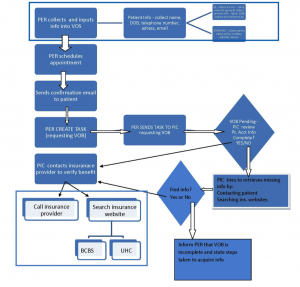
Enclosed is an example of a new patient intake process for a practice:
Write here…So break out the whiteboard and document your key processes that manage 80% of the work!
STEP 3: Now it’s time to review the processes for efficiency. Many practices, including ours, have redundant or inefficient process. The reasons for this problem are varied. In our practices, we created redundancy to ensure that our data entry was correct. We are always in the process of improving and “Leaning” out our key processes. This really is the next critical step in process improvement.
As defined by Wikipedia, “Lean is a production practice that considers the expenditure of resources for any goal other than the creation of value for the end customer to be wasteful, and thus a target for elimination. Working from the perspective of the customer who consumes a product or service, “value” is defined as any action or process that a customer would be willing to pay for. Essentially, lean is centered on preserving value with less work.”
This is typically done in conjunction with a synergistic methodology of Six Sigma. Wikipedia defines Six Sigma as “a process improvement set of tools and strategies…which seeks to improve the quality of process outputs by identifying and removing the causes of defects (errors) and minimizing variability in manufacturing and business processes.”
Below are some of the key elements/areas of focus for both methodologies.
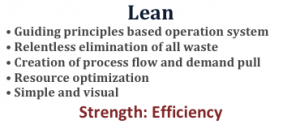
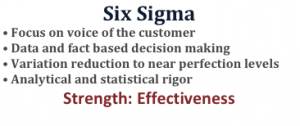
When it comes to process improvement, both Lean and Six Sigma are important, therefore you may hear the term “Lean Six Sigma” used often. So for fun, let’s process map this out.
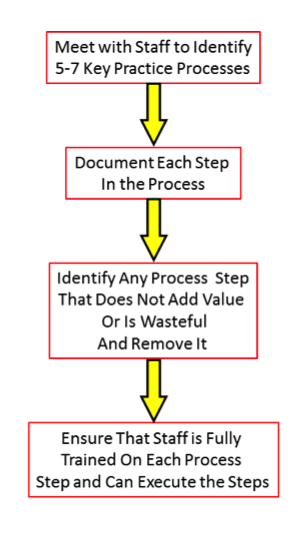
Remember, adding value means “something that the customer is willing to pay for.” You have to keep in mind you have both internal (fellow staff members) and external (patients, referral sources etc.) customers. There also may be exceptions where the customer might not be willing to pay for it, but it’s an essential step in the process for your practice. The idea behind Lean is efficiency, so don’t get too caught up in the definition of value if you find it’s impairing your ability to make decisions and move forward. Remember, for those of you who don’t have (1) your process documented and (2) your team well trained on them, even just doing the first two steps is going to have a huge impact for your practice.
STEP 4: Do your best to remove inefficiency, and then, as the last step states above, train, train, train your staff.
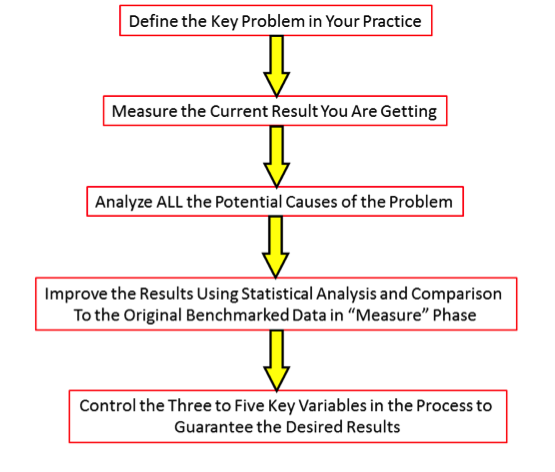
STEP 5: Process Improvement Part II. After working with your new process for 90 days, have a follow up meeting with your staff about the next level of process improvement. Every practice has business challenges, so one of the best ways to address those challenges and implement long lasting solutions, is the use of Six Sigma. Six Sigma follows the DMAIC methodology:
• Define the Problem
• Measure the Problem
• Analyze the Problem
• Improve the Problem
• Control the Solution to the Problem
The idea behind Six Sigma is that in any given business process, there are 3-5 key steps in that process that must be controlled to get the desired result. This methodology came about because of the business problems at Motorola. Back in the 1980’s, Motorola was manufacturing pagers. Because of manufacturing process flaws, once the pagers came off the assembly line and were being tested before going to market, many didn’t work properly. Why?…because there was variation in the manufacturing process that caused defects in the final product. Defects cost money – They cost money to fix, but even more importantly, they also reduce customer loyalty. Think about you as a consumer. When you go to your favorite restaurant and get your favorite dish, you want the same great meal every time. If there was variation each time you went (too hot, too cold, over-cooked, under-cooked etc.), then most likely your favorite restaurant would be someplace else! Whether manufacturing food, pagers, or healthcare outcomes and experiences, variation in process is EVIL!
So, Motorola needed a solution and needed one fast. Leadership and engineers implemented Six Sigma and to say the results were staggering is an understatement. Six Sigma processes resulted in $16–17 Billion in savings to Motorola as of 2006!
This can work for your practice as well. So, when dealing with a practice issue, following the DMAIC methodology can have tremendous impact on your practice’s quality and bottom line.
Lean Six Sigma requires an investment -an investment in time and an investment in learning. The DMAIC process revolves around data (see last month’s article), so it will take time to learn, collect and analyze the necessary data, and make continuous improvements. That being said, the investment is well worth it because the ROI is a consistent and improved practice. The good news is that there is lots of information on Lean Six Sigma – books, audio cd’s and even FREE ONLINE LEARNING! Yes, I said “FREE”. No catch, no upsell, just plain, good ole fashion free. As a member of the ACA, I will provide this information to you. All you need to do is contact me at [email protected], and I will connect you with the online training company that can help you and your staff take the next step to maximize process improvement! Good luck and I look forward to hearing from you about your successes!
1. Wickman, Gino (2012-04-03). Traction: Get a Grip on Your Business (Kindle Locations 2276-2280). Perseus Books Group. Kindle Edition.

by Kaizenovate Team | Apr 29, 2016 | Blog
In this month’s article, we’re going to be discussing the third element of the Entrepreneurial Operating System (EOS), data. Remember, the six major categories of discussion include:
1. Vision
2. People
3. Data
4. Process
5. Issues
6. Traction
I remember some of my first practice management seminars learning about metrics from the likes of chiropractic practice management legends Dr. David Singer and Dr. Larry Markson. PVA, patient visit average, was a concept that I learned and implemented in my practice. It was in fact, the first metric I ever learned about. Now since the beginning of my practice, I’ve always set goals – new patients, billing, collections, etc. But in the early years, before learning about PVA, I had to wait until the end of the month to determine how I was doing. Did we hit the goals or not? Once I was taught PVA, it was a great way to predict how much productivity I could achieve from seeing a certain number of new patients. Of course today, PVA is a mainstay in most practices.
As my practice, and its associated complexities, grew, things got exponentially tougher. I needed to figure out why things weren’t going the way that they I wanted them to go. For a long time, I guessed and used “hunches”, but I learned that understanding the data behind my performance was going to be critical if I was going to get my practice where I wanted it to be. (Author’s note: It’s not there yet, so for all of us, it’s a continual work in progress!). In 2003, we had expanded to four offices, purchasing our first existing practice. It was an exciting time…until the money dried up. Yes, that’s what I said, the money dried up. We had four locations with four different operational structures and it was not going well. Patients were being seen, claims were being submitted, but no money was coming in. During this time, managed care started to get its ugly grip on us. More forms, different forms, more requirements on HCFA’s etc…It was bad, really bad. In fact, we were about to go out of business.
I realized, I needed to do something quick because this wasn’t about anyone on my team. This was about me being a poor leader and making bad decisions. And I had made a lot of them to get us to that point. So, the first thing we did was to reorganize the business and create a central business office. From this starting point, we could manage and monitor the entire back end operation of the practices in one location with appropriate management supervision and support. The second thing we did was to make decisions based on data. We figured out that if we monitored a leading metric like the number of data entry defects before the claims were sent out, we could (1) catch and fix those claims, so they would be submitted cleanly and thus get paid quickly; and (2) provide training and support on the specific areas where a team member was performing poorly. It literally saved our practice. To this day, we still use the “Demo Defect Report”, a portion of which is shown below:
This is one of the many daily, weekly and monthly reports, outside of standard financial reporting, that are worked and communicated in our company consistently. It has taken years to create and consolidate the right kind of data – data that helps us predict, and in many cases improve, our outcome – that has real meaning to the company.
So what about you? What are your leading metrics? Maybe an even more important question is what are your biggest practice problems?
For the sake of example, let’s say it’s hitting your practice’s billing goals. Your new patients have been at goal, but for some reason, you’re not ever able to hit your billing goal and thus your revenue goal and thus your profit goal. What should you do? You can guess as to why that is, and make decisions to change things in your practice, but you’re “hunching” it at that point and if you’re “hunching” wrong, you won’t get to where you want to be. What I would suggest is first identify all the potential variables that might lead to having enough new patients, but not hitting your billing goal, just by drilling down.
Let’s make a list:
1. PVA. I know, that was an easy one! But let’s drill down a little more…what is one obvious potential variable to not having a strong PVA?
o High self-discharge rate. What are the variables that tie to a high self-discharge rate?
2. Not meeting or exceeding ANY aspect of the patient experience. What ties to not meeting or exceeding ANY aspect of the patient experience? Some examples:
· Poor patient education. Why is this happening, how do we measure, and how do we fix and then measure its improvement?
· Poor environment (dirty/disorganized office). Why is this happening, how do we measure, and how do we fix and then measure its improvement?
· Poor treatment response/experience. Why is this happening, how do we measure, and how do we fix and then measure its improvement?
· Poor customer service. Why is this happening, how do we measure, and how do we fix and then measure its improvement?
· Poor financial policy and procedures to help patients with financial hardships. Why is this happening, how do we measure, and how do we fix and then measure its improvement?
· There’s lost more, and there are even external factors that are beyond our control, but I think you get the picture.
So to summarize, what’s the problem solving, data dive process?
1. Figure out ALL the potential variables that tie to a given business problem.
2. Determine which are the top three variables that need to be corrected.
3. Measure those variables in a way where you can establish a baseline and identify trends
4. Determine the best solutions to solve the most obvious and pressing issues first, based on what the data is telling you.
5. Measure your results.
6. Repeat, until you get the results you are looking for!
As you go through this problem solving process, its’ critical to incorporate the feedback of your entire team. They are the ones working on the front lines and they often know not just what the problems are, but how to solve them. If you have front line people who don’t know, then maybe you have the wrong people on the bus or the right person on the bus, but in the wrong seat. Great teams start with great individual contributors, and you can’t solve your practice problems without great people providing input. And by the way, you may not always like what you hear from your team. Maybe YOU’RE the problem in a certain situation that needs to be fixed in one way or another. You know what, we’ve ALL been there. I’ve needed to be “fixed” more times than I can count. But you know what? All that feedback about what I can do better, makes me a much better leader and thus helps me to improve the lives of my team and the lives that my team works to help every single day. So be open to the information you get from your team!
Speaking of feedback, keep it coming at [email protected], and l can’t wait to hear more stories about your successes!
by Kaizenovate Team | Mar 31, 2016 | Blog
In this month’s article, we’re going to continue our focus on people – your most important asset. If you recall from previous month’s articles, we are going to be discussing the elements of the Entrepreneurial Operating System (EOS). The six major categories of discussion include:
1. Vision
2. People
3. Data
4. Process
5. Issues
6. Traction
PEOPLE PROCESS
1. Develop your Human Capital Infrastructure
2. Hire the right people and put them in the right seats on the bus
3. Lead them in a way that you don’t DE-motivate them.
Last month we discussed #1 below: Developing your human capital infrastructure. This month we’re going to tackle #2 again, but with a different element: Hiring the right people and put them on the right seats on the bus. Next month, we’ll discuss the SCIENCE behind human motivation, what author Daniel Pink calls, “Motivation 2.0.”
So, now to hiring the right people…thinking…thinking more…this is THE toughest thing to do as a leader. I live the hiring challenge just like many of you do. How do we really know if these candidates are going to perform? The truth is, we don’t. All we can do is improve our odds, so here’s what we do and here’s what we plan on doing in the near future.
Step 1: Recruiting: For us, it starts with Craigslist. We used to use a variety of higher priced channels, including recruiters but at the end of the day, Craigslist has been working out really well. We also have ads placed for many of our positions continuously. Why? Having a pipeline of resumes to choose from and reach out to in the unexpected event of someone leaving suddenly, can save your practice. Further, have you ever been in a situation where an employee was not a good fit, but you hesitate to post an ad because you’re worried they may be looking to see if you’re posting an ad? Having a company policy of “Talent Management Pipeline” let’s your folks know that you’re always looking to ensure they are being supported with the best team members. When unforeseen events happen, you will be much more prepared.
Step 2: First response: For each position in our company, we have designed 8-10 questions that screen out the candidates. Questions range from experience to values to available hours to pay expectations. Once we see a resume that we like, we email out the questionnaire, evaluate responses and then set them up for a group interview.
Step 3: Group interview: We LOVE group interviews. First and foremost, it’s very efficient. Second, it allows you to see how people interact with each other in a very stressful situation. One time, a woman who appeared to have all the right skills and qualities, bashed another candidate mid-way through the interview process. I knew we didn’t want anyone like her on the team, so I politely excused her from the rest of the interview. You get to see true behavior and character come out in these situations, especially if you can create a professional but relaxed environment. Further, in the interview process, we ask behavioral/situational questions like, “Tell us a time when you demonstrated great sacrifice to get an important job or task done.” There are many questions like the above, so you have to design questions that tie to what your values and goals are for your practice. I also list each candidate on a spreadsheet and score them for every question. At the end, the candidates with the highest of the scores have a chance to move on to the next round (see below). My favorite question is my last question and now it can be yours too…it is… “Who in this room would you hire and why?” The candidates now have to make a decision – do they say themselves? Do they say another candidate who may be more qualified than they are? It creates an amazingly interesting dynamic. When you have a lot of agreement in the room of the best candidate chosen by the candidates, that’s a pretty good indicator that there’s good potential for the one everyone likes the best. Sometimes they are the right one, and sometimes they’re not, so to improve your odds, take the highest scoring and most chosen (by their peers) candidates through the next step below. Lastly, I always like to give a brief history of the company and discuss the culture. We are very clear about who we are, what we expect and what we give in return. There’s no use telling a candidate your practice or your team is one way, when it’s just not that way. Honesty is appreciated by you and it is appreciated by the interviewee. There have been more times than I’d like to admit where I had said to a candidate, “Our A/R is a train wreck. Here’s what it looks like. What would you do first?” This lets them know what they’re getting into. Those who are up for the challenge are exactly the people I want on that seat in the bus!
Step 4: Working Interview: Once we have a few candidates we like, we ask them to come back for a working interview. Here they sit with our best people and/or their potential future teammates and we get a qualitative assessment of them – their skills, their character, their habits. I will be the first to tell you that this is an area that we want to improve on in our company. There have been candidates that pass Steps 1-4 with flying colors, but then in the job, they’re not the same. So, we’re working on improving our next step in the process which is…
Step 5: Testing: We do two types of testing – (1) Job specific tests where we ask very pointed questions that directly tie to their job role; and (2) behavior type testing that tie to who the candidates are as people. There are some really interesting behavior tests out there from a variety of companies, but three that peak my attention are
a. 5Dynamics (www.5dynamics.com): This testing methodology determines an individual’s energy and how they prefer to work in four major areas: (1) Explore, (2) Exam, (3) Examine and (4) Execute. When I took my test, I was absolutely amazed how accurately it represented me.
b. The MPO Personality Assessment from Excelsior (www.excelsiorp3.com): This test identifies seven behavior variables and their interactions and produces a report that allows leaders and their teams to function with greater capabilities.
c. The Enneagram (www.enneagraminstitute.com): This test categorizes 9 different personality types and puts the individual into a basic personality type through the answering of the enneagram questions.
We know that there are many more tests out there. Find one that works for you and your practice and the likelihood that the candidates actually deliver on their interview promises will surely increase.
Some final thoughts: Getting your team involved in the interview process can be really helpful. They’re working with the new hire, so they should have a say in the process. You may not always agree with them, but if you’re clear why you made your decision, they should understand if you went with someone that was not their first choice. Keep in mind though, that mediocre employees will derail you from hiring people they perceive as better than them. Listen to your gut, follow the comprehensive steps above, and build your dream team. Once the hire has been completed, put the new employee through the steps from the last month’s article.
1. Review their employee handbook with them
2. Review their job description with them and have them sign it
3. Review their job competencies with them
4. Outline the training process, and the expected result of their completed training
5. Perform your 90 day review with them.
Hiring great people is one of the most difficult tasks we have as leaders. After almost 20 years for us it is still a work in progress. While I’ve shared my process with you, I’d love to hear more about what’s worked for you in your practice. Feel free to email me at [email protected] and in next month’s article, I will share your story with the rest of the profession so they can learn even more from your successes. I look forward to hearing from you!
by Kaizenovate Team | Feb 29, 2016 | Blog
“First who, then what…” Famous words by Jim Collins, author of Good to Great. Of all the challenges leaders face – strategy, competition, and financial acumen – the people “thing” is by far the hardest. Why? It’s because people are not predictable. In fact, some might say that people are “predictably irrational” (see Predictably Irrational: The Hidden Forces That Shape Our Decisions by Dan Ariely).
If you recall from last month’s article, we are going to be discussing the elements of the Entrepreneurial Operating System (EOS). The six major categories of discussion include:
1. Vision – last month’s article
2. People – the next three months articles
3. Data
4. Process
5. Issues
6. Traction
So, what will it take for us to become leaders who actually enjoy leading their people to the desired vision and mission? A LOT! But, if you follow these steps, you’ll be on the road to having a much easier (and enjoyable) time building the practice of your dreams.
Building your dream team takes 3 major steps:
1. Develop your Human Capital Infrastructure
2. Hire the right people and put them in the right seats on the bus
3. Lead them in a way that you don’t DE-motivate them.
DEVELOPING YOUR HUMAN CAPITAL INFRASTRUCTURE
Pop Quiz time! Please answer the following questions and score accordingly. We will tally this up at the end:
1. Does your practice have a professionally (Attorney) written employee handbook that spells out all of the information of your practice and the employees’ rights and general responsibilities?
a. No = 0
b. Yes = 3
c. Yes and Signed By All Employees and Housed Centrally = 5
2. Do you have clearly written and concise job descriptions?
a. No = 0
b. Yes = 3
c. Yes and it’s signed by all employees and housed centrally = 5
3. Do you have clearly written and concise job competencies?
a. No = 0
b. Yes = 3
c. Yes and part of your interview process and performance reviews= 5
4. Do you have job training manuals with checklists?
a. No = 0
b. Yes = 3
c. Yes and signed by trainer and employee = 5
5. Do you have at least annual performance evaluations?
a. No = 0
b. Yes = 3
c. Yes and Specific Development Plan Given to Employee for Upcoming Year = 5
So now add up your score and multiply times 4. If your scores are:
v90-100 = You have Outstanding HCMI
v80-89 = You have Solid HCMI
v70-79 = You have Average HCMI
v<70 = You have Lots of Opportunity for Improvement
When I first started in my practice, my score was a “0”! Mid-way through my development it was about a “20”! Now, I approximate “100”. Its taken years to get to this point for my practice so I’m hoping with some clear guidance, you will get there much faster. Let’s discuss solutions to the above five questions:
1. Employee Handbook. An employee handbook is essential for both legal reasons and for employee performance reasons. While I strongly encourage a handbook that is prepared by an expert in employment law in your state(s), there are some interesting tools online that can at least help you get started with what policy decisions you want to make. RocketLawyer.com has a free tool that will allow you to create a semi-customized handbook and receive a PDF version of it. So, instead of taking two to five hours of an attorneys time to walk you through your decisions, you can walk through this online step-by-step process and at least make decisions on how you’d like to structure things like vacation, benefits, employee complaints etc…To start a free sample handbook, go to http://bit.ly/PmcVrs. After you create this, you can then go to a local trusted employment attorney, and have them make revisions based on any additional needs, state requirements etc. Be sure to always call first and ask “how much do you charge to create a completely new employee handbook?” Then ask, “If we have an existing handbook that we’ve prepared, how much do you charge to edit and update?” You may be able to save a fair amount of money if you don’t have to start from scratch!
2. Job Descriptions. It is critically important that you have clear and concise job descriptions for your employees. They must know their expected roles and responsibilities and will be very useful to ensure that performance meets your expectations. Job descriptions are a snapshot of what their day “looks like”. Writing job descriptions that are quantitative in nature can also be very helpful. For a CA for example, “Answer all phones within the first three rings and ensure that if you are addressing a patient in person while the phone rings, you apologize for the interruption and will re-address them quickly” or “Reschedule, on average 80% of the patients. When a patient refuses to reschedule for the same week, email the doctor to inform him of non-compliance.” Specific targets help you create expectations of performance and when expectations are not being met, you can address them with true quantitative data.
3. Job Competencies. While job descriptions are “what” your employees do, job competencies is “how” they do what they do. It’s been defined as “the knowledge, skills and observable behaviors working in concert to produce outstanding performance.” Competencies can be divided up by “core” (e.g. communication, organization, professionalism etc.) or job specific (e.g. budgeting, sales skills, clinical acumen etc). Job competencies are very descriptive and tell your team how they should be doing their job. Think of an associate and how you would align a job description item (Perform re-exams every six visits) with a competency (communication – “Communicates well both verbally and in writing, creates accurate and punctual reports, delivers presentations, shares information and ideas with others, has good listening skills. Can get messages across that have the desired effect. Communicates clearly and succinctly using a variety of styles either with an individual or within a group setting”). Yes, maybe they did their re-exams every six visits but did they communicate the patient’s progress effectively? If you want outstanding performance, you have to be able to have your description and competency infrastructure clearly outlined so you can teach, discuss and measure performance!
4. Training Manuals and Checklists. All of the job descriptions and job competencies should be part of a broader training manual. The manual is a living breathing document in that it always needs to be updated so ensure you have an electronic version that is in one central location and is backed up daily. Training manuals should outline the key processes for each of the job description items. Normally a great training manual documents the key 20 percent of the processes that get 80 percent of the work done. If you can get to all of your processes being documented, you are that much better off. Training checklists ensures that your trainer and trainee agree that the trainee has been trained. Both should sign off on the training checklist, NOT when the information has been reviewed, but rather, when the trainee feels like they can perform the job task in the way the practice intends it to be performed. Remember, your training is only as good as your BEST trainer, so invest some time and some capital in ensuring you’ve got someone on staff who is a great trainer.
5. Performance Evaluations. When you bring on employees to your team, to ensure the best probability of success within your human capital infrastructure, you must close the loop. You do that by doing performance evaluations. Our cycle is each new employee gets a 90 day review and then an annual performance evaluation. The evaluation should be no more than 10-15 elements that are scored and discussed qualitatively. They should include the employees job specific competencies, core competencies and how their work reflects the practices core values. There are some important considerations with performance evaluations:
a. If you do a performance evaluation and your employee is completely shocked by what they’re reading and hearing, you have not done a very good job of engaging them throughout the year. Having regular, informal conversations about performance is MUCH more important than never having discussions and just doing one formal evaluation at the end of the year. So the lesson, meet with your teams regularly to discuss performance!
b. Make sure if you are scoring an employee quantitatively, you have “calibrated” the scores. Define to them what a “3” or a “4” or a “5” looks like in terms of specific performance. Performance reviews should be self-scored as well as scored by the employees manager. The discussion around scores and comments is more important than the scores themselves. The more the scores align, the more you realize alignment on expectations
c. Having a performance review without a development plan is meaningless. You’ve told them what they’ve done well, you’ve told them what you’d like them to improve on, now have a discussion with them on HOW to improve. Try to support them in having them come up with the solutions themselves. You telling them what to do, as bad as you (I) want to, will not be as impactful as if they can come up with the solution and the benchmarks (time-based measurements) themselves.
In conclusion, you have to have good infrastructure (architecture) to be a successful and sustainable company in today’s marketplace. If you need some work on these above areas, get them done over the next 30 days so you can take the next step in our journey together next month – Hire the right people and put them in the right seats on the bus!